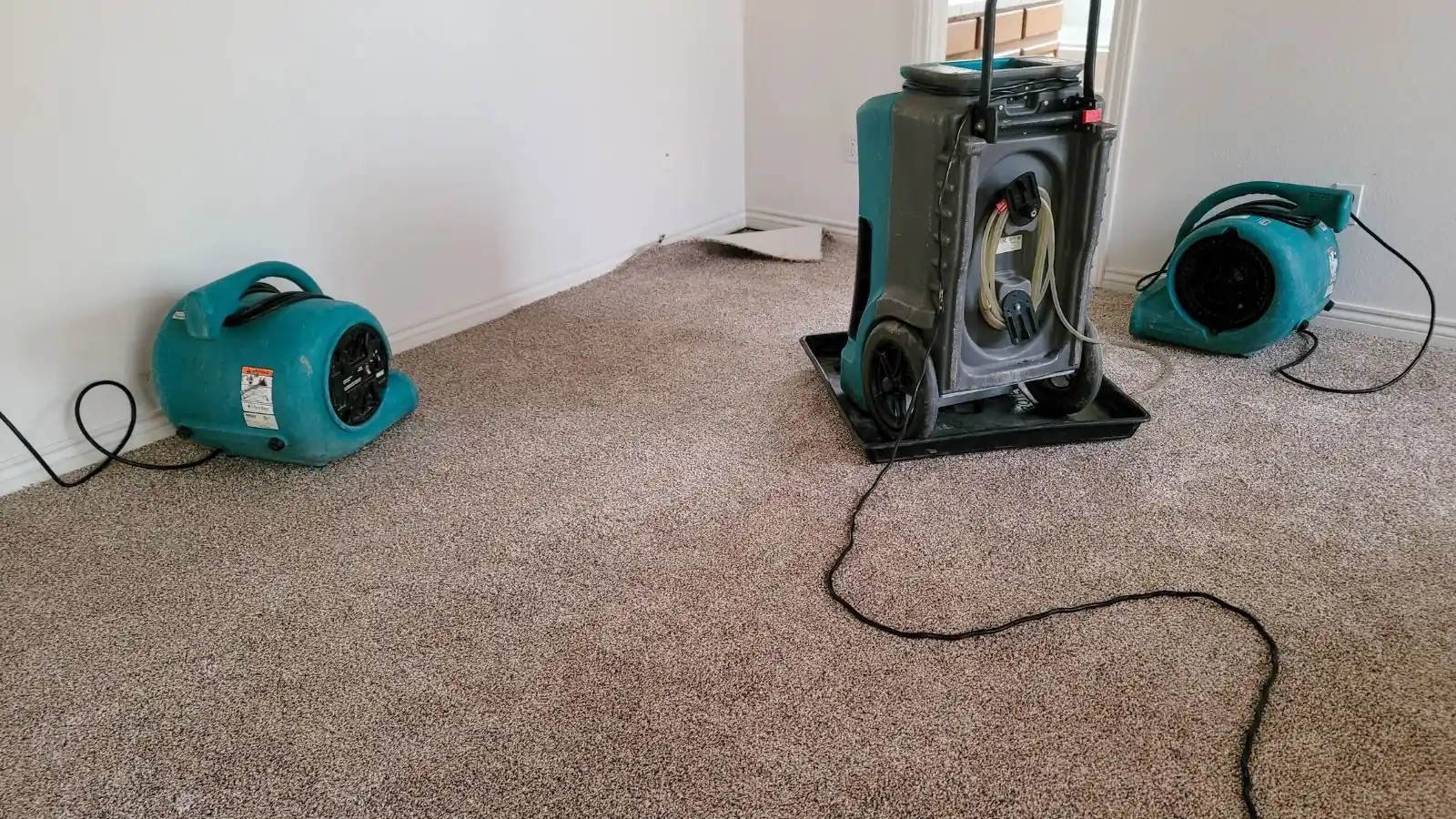
Water damage in a Selden, NY home usually takes a few days of equipment drying when the loss is small and the water was clean, and longer when thick or dense materials are involved. Nobody can honestly name an exact number before the damage is measured. What can be said is that wet materials should be dried within 24 to 48 hours of the leak, per EPA guidance, and that drying is finished only when moisture readings say so.
This post explains what stretches or shortens the timeline, how the equipment works, and how a crew knows a wall or floor has actually reached a dry reading.
Why the 24 to 48 hour mark keeps coming up
Mold needs moisture and organic material, and drywall paper, wood framing and carpet backing all supply the second part. EPA guidance is to get wet materials dry within 24 to 48 hours so growth does not get a foothold. That window is a target for starting and finishing the drying effort, not a promise that every material will be dry by day two.
In practice, the clock starts when the water stops, and the first move is removing standing water. Our page on water extraction covers that step, since a floor with an inch of water on it cannot begin drying until the pumps have run.
What sets the drying time
| Factor | Tends to dry faster | Tends to dry slower |
|---|---|---|
| Water category | Clean supply water caught early | Gray or black water, where porous materials are removed and replaced |
| Amount and spread | One room, one wall section | Several rooms, water that ran through a floor or wall cavity |
| Material | Thin vinyl, tile, painted drywall | Hardwood, plaster, concrete, thick carpet pad, packed insulation |
| Time before action | Water removed the same day | Wet for several days, with swollen or warped materials |
| Air in the house | Moderate temperature and low humidity | Humid, cool or closed-up spaces such as basements |
| Equipment and setup | Enough air movers and LGR dehumidifiers, placed by moisture map | Too few units, or doors and cavities left closed |
For rough planning only, drying a small, clean-water loss with equipment often runs about three to five days. Wet hardwood, plaster, concrete or insulation inside walls can take a week or more. These are general ranges and not a promise for your house. Your own number comes from measurements.
Talk to dispatch about your situation.
Call (934) 223-1875How the equipment actually dries a room
Drying is evaporation management. Air movers push a thin layer of dry air across wet surfaces so water leaves the material, and LGR dehumidifiers pull that vapor out of the room and discharge it as liquid. Without the dehumidifier, the vapor settles back into drywall and trim.
Sealing the room matters. Open windows let in outdoor air that may carry more moisture than the house, and a dehumidifier works best in a closed space. That is why crews ask you to leave the equipment running and doors shut, even though it is loud.
Wall cavities, subfloors and the space under cabinets hold water that surface fans never touch. Crews drill small holes, lift baseboard or use cavity drying systems to move air inside those spaces. The full method sits on the structural drying page.
How drying is verified with moisture readings
On day one a technician maps the wet area with a moisture meter and a thermal imaging camera. The camera spots cool, wet zones on the surface, and the meter gives numbers. Readings are logged at set spots and compared each visit.
Dry is defined against your own house. The crew takes readings on the same kind of material in an unaffected room, such as a dry wall section or an undamaged stretch of floor, and uses that as the goal. A reading near the goal, held across consecutive visits, means equipment can come out.
- Readings are written down with the date, location and material type.
- The wet area shrinks on the map from one visit to the next.
- Drywall, framing and subfloor all reach the goal, not just the paint surface.
- Equipment is removed only after the final set of readings is recorded.
- Those logs can go with your claim file as part of the written scope.
When the plan changes from drying to removal
Some materials do not come back. Soaked insulation, carpet pad and drywall that touched sewage or flood water are usually cut out and replaced, and swollen particleboard rarely recovers. Cutting a wet section out can shorten the overall timeline, because a dense layer no longer sits in the way of the airflow.
Hardwood has its own pace. Boards cup as they take on water and need to dry slowly, and refinishing waits until readings come down. If you have a floor like that, the hardwood floor repair page explains what to expect.
While equipment is running
Keep children and pets away from cords and hot dehumidifier exhaust. Do not stack items on wet carpet or against wet walls. If equipment trips a breaker, leave the panel alone unless it is dry and safe to reach, and call us instead of resetting it repeatedly.
Drying after Long Island storms and in Selden basements
Long Island gets nor'easters and tropical systems, and in August 2014 more than 13 inches of rain fell at Islip in about a day. After a storm like that, outdoor air is saturated, so propping windows open to help a wet room dry usually makes things worse. Closing up and dehumidifying inside is the better approach.
If groundwater or runoff keeps re-wetting a basement, drying will stall until the water entry is fixed. Restoration is not waterproofing, so ask the Town of Brookhaven or a waterproofing contractor about the cause, and check the FEMA flood map for your address.
We dispatch around the clock to Selden and to the lake-dotted Middle Island area, where saturated ground after heavy rain can keep a lower level damp, as well as harbor-side Mount Sinai.
Questions we hear in Selden
Can water damage dry on its own without equipment?
Surface moisture will evaporate over time, but water trapped in walls, subfloors and padding often stays behind. That hidden moisture is where mold growth tends to begin.
If the loss is small and clean, a fan and dehumidifier help. Anything beyond one wet spot is worth measuring.
How do I know when my floor or wall is truly dry?
The only reliable way is a moisture meter reading compared with an unaffected area of the same material. Touch and smell cannot do that job.
Ask for the final readings in writing before equipment is removed and repairs begin.
Why is my dehumidifier still pulling out water after a week?
It is likely still removing moisture from materials and air. Output usually drops as the structure dries.
A drop in collected water paired with dry readings is the signal that the job is ending, not the passage of days.
Does a cold or humid day change how long drying takes?
Yes. Cool, damp air holds less extra vapor, so evaporation slows and the dehumidifier has more work. Heat and low humidity speed it up.
That is why a closed, controlled room dries more predictably than one open to the weather.
My Selden basement keeps getting damp after rain. Is that a drying problem?
Probably not only a drying problem. If outside water keeps coming in, the room cannot reach a dry reading.
Find and fix the entry point first, which is a job for a waterproofing or drainage contractor, then dry the space.
Ready to talk it through?
Call (934) 223-1875