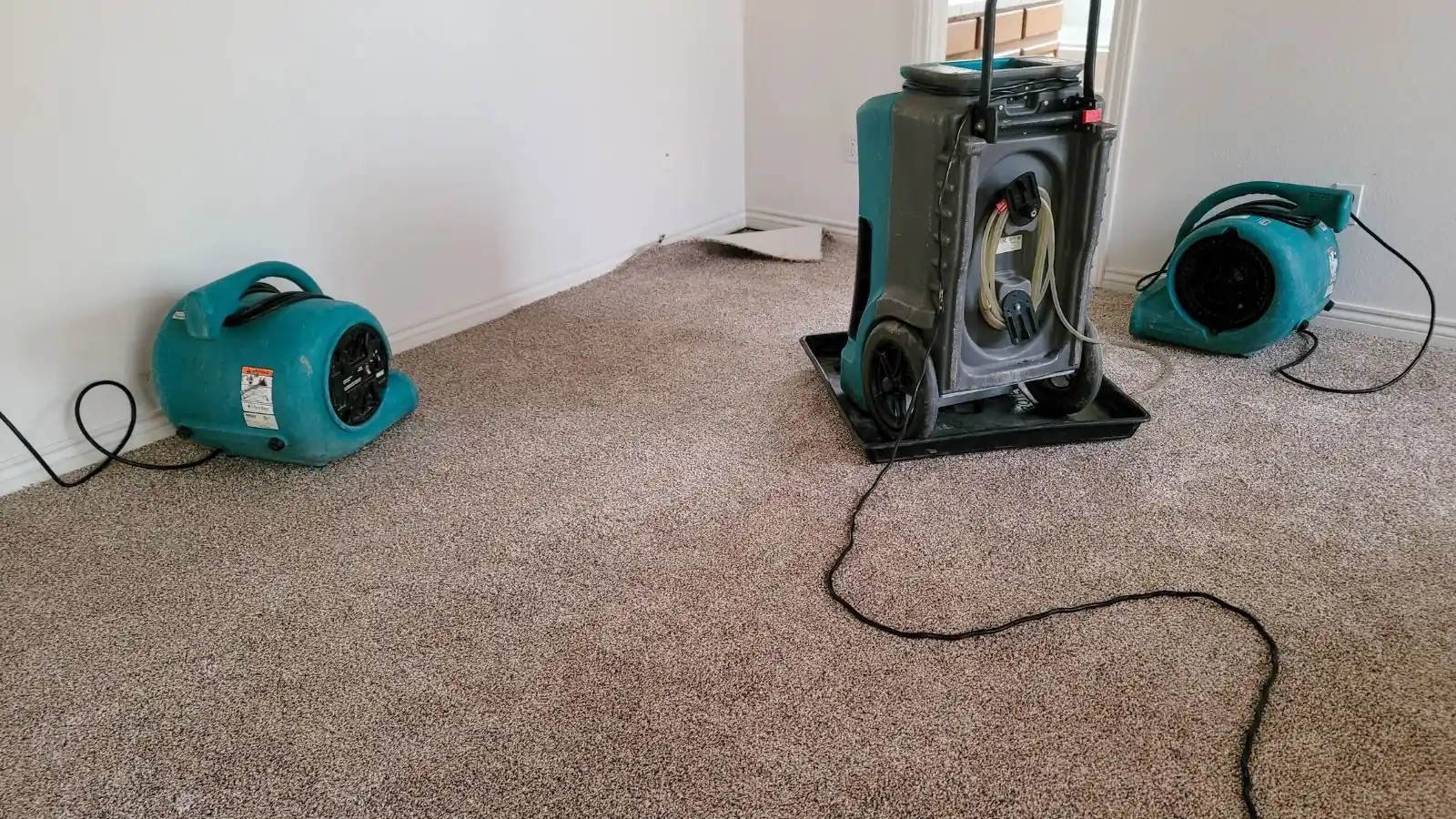
Structural drying is the controlled removal of moisture from framing, subfloors, concrete, walls and ceilings after a leak or flood. Done properly in Selden, NY, it uses moisture meters, thermal imaging cameras, air movers and LGR dehumidifiers, with daily readings that decide when to stop.
EPA guidance is to dry wet materials within 24 to 48 hours, because mold needs moisture and organic material to start.
The fans have run for days and my house still feels damp
That usually means the surface is dry but water is still trapped in the wall cavity, subfloor or slab. The trade that fixes it is called structural drying, and it works from readings rather than feel. It is different from running a box fan and hoping.
Water mitigation: stopping the loss before drying begins
Water mitigation is the first phase of a loss. The source is stopped, standing water is removed, materials that cannot dry are taken out, and what remains is protected. Drying then starts on a smaller, cleaner problem.
Mitigation limits damage, and restoration rebuilds. Ours begins with water extraction when standing water is present, and the notes from that stage become the record you can show your insurer.
Moisture mapping: finding every wet surface
Moisture mapping is a room-by-room record of where materials read wet. We take a dry reference reading from the same material in an unaffected area, then test in a grid across floors, wall bases and ceilings.
A thermal imaging camera shows cool, damp patches behind paint and tile. The map is marked, photographed and compared again each day, so you see the wet edge shrink.
Equipment and what each piece does
| Tool | Job | Where it goes |
|---|---|---|
| Moisture meter | Reads moisture in wood, drywall and concrete | Every affected surface, every visit |
| Thermal imaging camera | Shows temperature patterns that suggest hidden wet areas | Walls, ceilings and floors before opening anything |
| Air mover | Pushes air across wet surfaces to speed evaporation | Floors, wall bases and open cavities |
| LGR dehumidifier | Pulls moisture out of the air so materials keep releasing it | Centrally in the affected rooms |
| HEPA air scrubber | Filters airborne dust during demolition or after contamination | Where materials are cut or removed |
Water classes 1 to 4 and what they mean for drying time
Class 1
Small area with low-absorbing materials. Drying is short and often needs little equipment.
Class 2
A whole room, with carpet and pad wet and moisture wicking up the walls.
Class 3
Water from above, soaking ceilings, walls, insulation and floors. See ceiling water damage repair for the typical scenario.
Class 4
Dense materials such as hardwood, plaster or concrete hold water deeply and need specialty drying.
Class 4 jobs include a cupped floor, covered on our hardwood floor page. Water category is separate, with Category 1 clean, 2 gray and 3 black.
How drying days are run and when equipment comes out
- Day one: extraction, containment, material removal and equipment placement.
- Daily visits: new readings, moved equipment and adjusted humidity.
- Opened cavities: drilled or removed baseboards and wall sections let air reach framing.
- Final check: each material reads close to its dry reference.
- Equipment removal, then a written record of readings.
Houses built in the postwar growth that began in Selden in the early 1950s can have older drywall, paint and finishes, and a pre-1980 house may have materials that need testing before demolition. Test before opening walls so drying does not stop for surprises.
Stay safe around drying equipment
- Do not run extension cords through standing water or under rugs.
- Leave power to wet rooms off unless the panel is dry and safe to reach, and call 911 or the utility first for any electrical danger.
- Keep children and pets away from running equipment and collection hoses.
- Do not move or switch off equipment without calling us, because airflow patterns are set on purpose.
What changes the cost of structural drying
- Water category and class, which set the method and the materials removed.
- Square footage and volume of air that must be dried.
- Materials involved, from drywall to hardwood, plaster and concrete.
- Drying days and the equipment count that runs for them.
- Rebuild scope after readings show the structure is dry.
Call (934) 223-1875 and dispatch will explain the scope and price before any drying work starts. Sudden and accidental water damage is often covered by insurance, while gradual leaks often are not, so check your policy. Daily readings and photos support your own claim.
Where drying crews work
Our crews serve Selden and nearby Mount Sinai, where mixed housing eras mean different materials to dry. Call the 24/7 line and a same-day response is our goal when a crew is available.
Questions we hear in Selden
Why does my house still feel damp after I dried it with fans?
Fans move air across surfaces, but they do not remove moisture from the air, and they do not reach water inside walls or under floors. Without a dehumidifier and readings, moisture can remain in framing and subfloors.
What equipment is used and how long does drying take?
Air movers, LGR dehumidifiers, moisture meters and thermal imaging cameras are the core tools. Drying often takes several days, and dense materials such as hardwood or concrete can take longer. Daily readings decide when it is done, not a set number of days.
Can I use equipment from a hardware store?
Store-bought dehumidifiers help with humidity, but they are rarely sized to a wet structure. They also cannot tell you whether framing has reached its dry standard.
Is water mitigation the same as restoration?
No. Mitigation stops the loss and removes what cannot dry, and drying brings the rest back to a dry standard. Restoration rebuilds finishes such as drywall and flooring.
Does fast drying keep mold from growing?
Drying removes the moisture mold needs, so speed helps. No one can promise mold will never appear. If growth is suspected, mold remediation is a separate process, and the leak must be fixed first.
How do you know a wall is dry?
We compare readings to a dry reference taken from the same material in an unaffected area. When wall framing and drywall match it, equipment comes out.
Ready to talk it through?
Call (934) 223-1875